
How to Choose the Best Colour Analysis Training & Certification in 2026
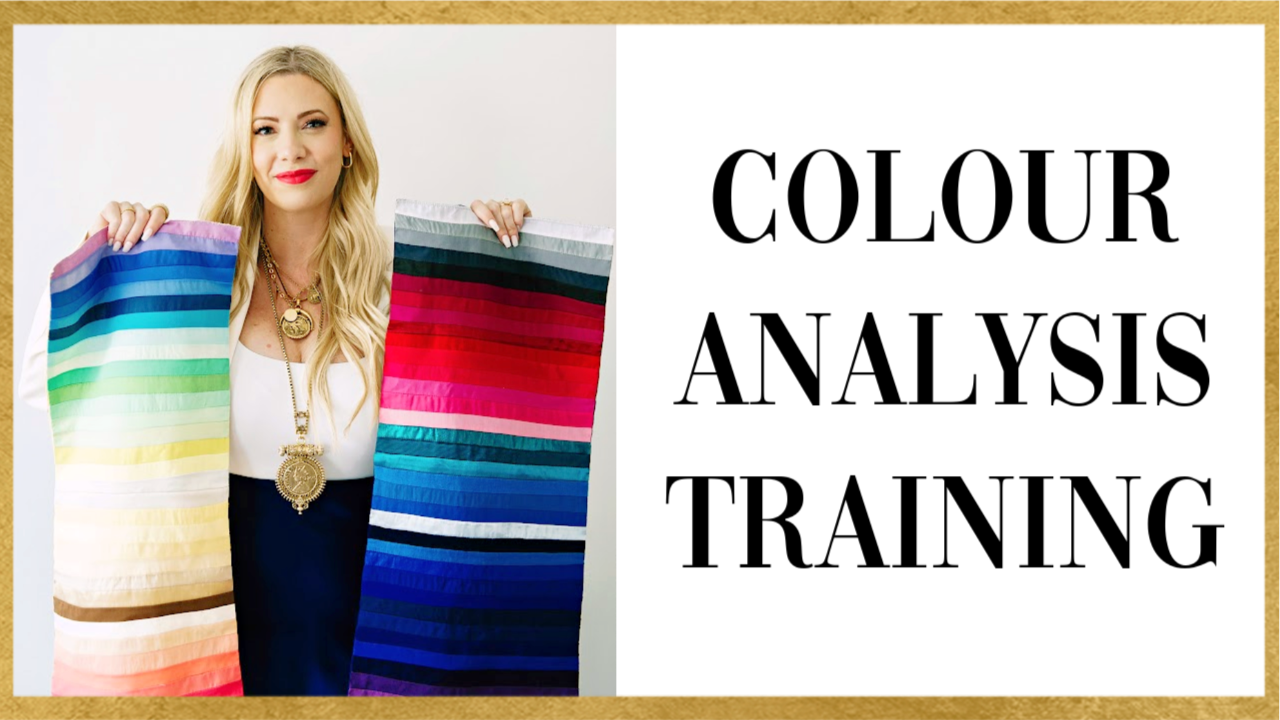
Colour analysis has exploded in popularity over the last few years.
What was once a service people associated with the colour parties of the 1980s has become one of the fastest-growing services across personal styling, beauty, hair and image-related businesses. And with that growth has come an equally large increase in colour analysis training and certification programs.
If you're searching for the best colour analysis training, you may be wondering:
- Which colour analysis certification should I choose?
- Is online colour analysis training as effective as in-person training?
- What colour analysis system should I learn?
- How experienced should my instructor be?
- And how do I know whether I'll actually be prepared to work with paying clients when I finish?
After working professionally in style, image and colour analysis for 19 years, I've developed some very strong opinions about what makes a great colour analyst and what you should look for before investing in colour analysis training.
Because knowing colour theory is important. Seeing colour on a human being is an entirely different skill.
1. Start With the Person Teaching You
Before comparing the number of modules, bonuses, colour palettes, or certificates included in a colour analysis course, look at the person who created it.
How long have they actually been performing professional colour analysis?
Not how long they've been interested in colour. Not how large their social media following is. How many years have they spent analyzing real people?
Personally, I wouldn't learn colour analysis from someone who has practised it for fewer than five years, no matter how impressive their social media following is.
Colour analysis requires pattern recognition.
After you've analyzed hundreds or thousands of people, you begin to recognize nuances that aren't obvious when you're new. You encounter people who don't look like the textbook examples. You see complicated undertones. You see clients whose obvious physical characteristics point in one direction while the colours themselves tell you something different.
You learn when to question your first assumption. You learn to stop looking for a season and start looking at the person in front of you.
You develop that kind of judgement through experience.
I've worked professionally in style, image and colour analysis for 19 years. During that time, I've performed colour analysis with real clients, taught colour analysis at George Brown College, delivered education to corporations and brands, taught hundreds of workshops across North America, and trained colour analysts around the world.
My work has also been featured through media including CTV News, Breakfast Television, Global News, CBC's Steven & Chris, Huffington Post, CHCH, Cosmo TV, Chatelaine, the Toronto Star and others.
I’ve also spent more than a decade training personal stylists and fashion professionals, both in the technical side of image and style and in how to translate that expertise into work with real clients. Being skilled at colour analysis and being able to teach someone else how to develop a trained eye are two different skills.
2. Ask a Surprisingly Simple Question: Does the Teacher Actually Wear Their Colours?
This may sound superficial. I don't think it is.
If I'm learning colour from someone, I want to see that they understand how colour works on themselves.
Look at your potential instructor. Look at their clothing. Their makeup. Their hair. Their jewellery. Their level of contrast.
Do their colour choices seem to enhance them, or do you notice the colour before you notice the person? Far too many wear their palette on occasion - or some don't seem to wear their colours at all.
A colour analyst's own image is one small piece of evidence, but it's meaningful evidence.
Because ultimately, the entire purpose of personal colour analysis is understanding the relationship between colour and the human being wearing it.
If that relationship isn't apparent in the person teaching you, I would ask questions. Understand the instructor's philosophy and viewpoint on colour and style. I believe that someone's closet should be filled with 95% of their palette, with a little room to go rogue and have fun with items that still call to you in your style. After all, fashion has to feel good to you first and foremost.
3. Colour Theory Is the Foundation. It Isn't Mastery.
Any reputable colour analysis certification should teach colour theory.
You should understand concepts including:
- hue
- temperature
- value
- intensity
- undertone
- harmony
- overtone
- contrast
- colour relationships
- simultaneous contrast
But understanding those concepts intellectually doesn't automatically make someone an excellent colour analyst.
This distinction matters especially if you're already a personal stylist, makeup artist or hairstylist. You may already understand colour. That doesn't necessarily mean you've learned to analyze the effect colour has on a person.
Professional colour analysis requires you to connect theory with observation, colour intelligence, harmony, and the biology of a person with a palette.
Theory gives you the language. Experience teaches you how to see.
4. Your Training Should Teach You to SEE Colour
This is one of the biggest things I would look for when comparing colour analysis certification programs.
You shouldn't simply be taught what a Spring, Summer, Autumn, or Winter looks like.
You need to learn what colour is actually doing to the person in front of you.
What happens to the skin? Do shadows become more apparent or disappear? Does pigmentation become more pronounced? Does the complexion become clearer? Do the eyes become brighter? Does the face become more defined? Does the colour overpower the person? Does the person disappear? Or does she suddenly come forward?
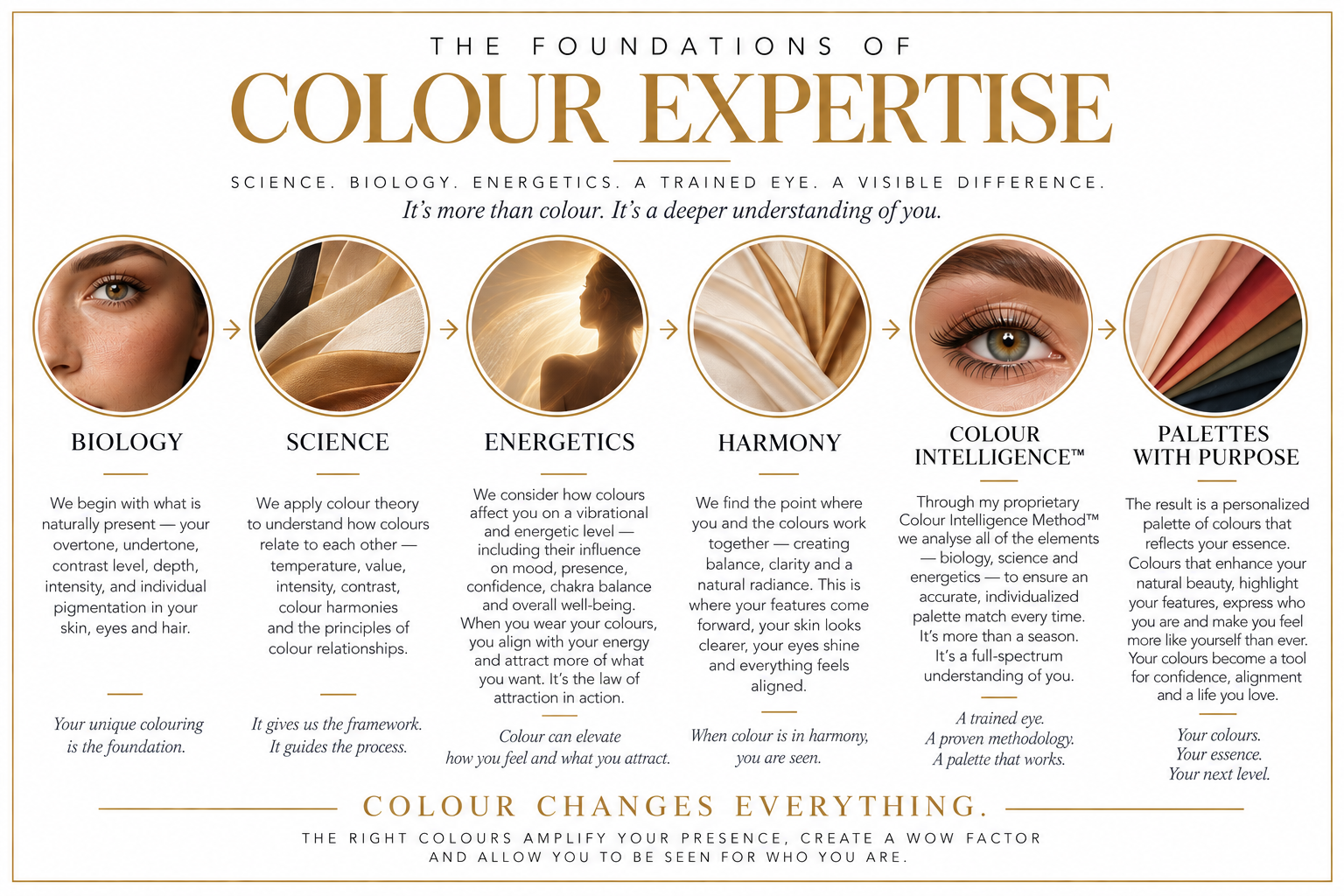
This is a major philosophy behind the Colour Intelligence Method™, the methodology I've developed through my 19 years of professional experience with colour.
Colour Intelligence™ goes beyond identifying characteristics and assigning a category. It teaches the analyst to observe the whole person, read the relationship between the individual and colour, understand the response they're seeing, and identify where the greatest harmony occurs.
Don't identify the colour. Read the effect.
Because the person is the point of the analysis, the goal is for her to be seen before the colour.
5. Look for a Colour Analysis System With Enough Nuance
Many colour analysis systems are available today. Some use four seasons. Others use 12. Some use 16 or more.
I teach an advanced 16-palette seasonal colour analysis system that begins with the four true seasons and moves into their seasonal flows.
Why? Because people are nuanced.
Two people may both be warm, for example, but require very different levels of intensity, depth, or contrast.
A more nuanced colour system gives the analyst additional places to explore when the traditional four-season model doesn't tell the entire story.
But I would caution against choosing a colour analysis training simply because it has the largest number of palettes.
More categories don't automatically mean greater accuracy - sometimes it can create confusion for the client. More is not always more.
The quality of the analysis still depends on the analyst's ability to see what colour is doing and on the client's ability to understand it, so they can trust the process and follow it to the end result.
6. Look for a Methodology, Not Just a Set of Drapes
Professional colour drapes are a tool, and important for colour accuracy.
But buying a set of drapes doesn't make someone a colour analyst any more than buying professional makeup brushes makes someone a makeup artist.
You need to understand why you're using them.
Strong colour analysis training should teach you how to observe a person through multiple lenses.
Within my own Colour Intelligence Method™, for example, we explore colour through the intersection of areas including:
Colour science: How colour behaves and how characteristics such as temperature, value and intensity interact.
Biology: The person's natural colouring, pigmentation and physical response to colour.
Visual response: What actually changes when different colours are introduced.
Energetics: The relationship between colour, vitality, presence and the individual.
These pieces of information work together. No single characteristic should automatically determine someone's palette. That's where professional judgement becomes so important.
7. The Training Should Include Real People
You cannot become proficient at colour analysis exclusively through slides and diagrams. You need to see colour on human beings. Lots of them.
Look for a colour analysis course that includes demonstrations, case studies, homework or practical analysis.
In my online colour analysis training, students see real clients being analyzed and learn how different palettes present themselves in practice. Students also complete interactive homework, and certification requires submitting work that demonstrates a clear, accurate understanding of the colour analysis process. They're asked to analyze clients using the signature methodology to practice their skills and hone their eye, ensuring accuracy, confidence, and clarity when analyzing clients.
If work needs revision, students are asked to revisit the material and resubmit to receive their certificate and maintain integrity in their skills.
A certificate should represent demonstrated understanding, not simply proof that someone watched a series of videos.
One of my graduates, Joyce, had previously completed colour analysis training elsewhere but told me she still felt she was working in a formulaic way because she didn't understand what she was seeing. She described my method as the point where colour finally "clicked" for her. Within two weeks of finishing the training, she had recouped her initial investment through her own clients, and everyone is thrilled!
8. Make Sure Feedback Is Part of the Training
This is especially important with online colour analysis certification.
Self-paced education can be incredibly effective, but you need somewhere to go when you're unsure.
You will encounter analyses where you're torn between palettes. You will second-guess yourself. You will see a client who doesn't look anything like the examples you've studied. That's normal.
Look for opportunities to submit work, ask questions and receive feedback from someone who understands the methodology.
My students get access to our private training community while completing the program, plus monthly live Q&A support and custom feedback on all homework.
One of the most important parts of learning colour analysis is being able to ask: "This is what I'm seeing. Am I seeing it correctly?"
Over time, that feedback builds confidence and professional judgement, helping you maintain accuracy and integrity in the field.
9. Can You Learn Colour Analysis Online?
Yes. But the training needs to be designed for it.
There is a major difference between taking a traditional in-person training and simply moving the same material onto a screen versus learning through a program intentionally designed to teach professional colour analysis online.
I've taught students to perform both in-person and virtual colour analysis, and I believe modern colour analysts benefit from understanding both.
For in-person analysis, students need to understand:
- lighting
- setup
- professional tools
- client preparation
- draping
- observation
- communiucation
- consultation flow
- Client tools and reports for success post-appointment
Virtual colour analysis requires a different skill set, including:
- photography requirements
- lighting
- client directions
- image evaluation
- digital analysis
- virtual consultation processes
- preparing client colour information
- commnication
- proper report layouts for clients and recommendations post colour analysis to ensure client success.
Virtual colour analysis can also give you access to clients well beyond your local market - everything is online nowadays.
So if you're comparing online colour analysis training programs, don't only ask whether the course is online.
Ask whether it actually teaches you how to perform colour analysis virtually. Those are two very different things. We will also have in-person training options available globally shortly.
10. Consider How Colour Fits Into the Work You May Already Do
You don't need to become an image consultant or a full-time colour analyst to benefit from professional colour analysis training. In fact, some of the professionals I've trained already had established expertise in completely different areas.
Makeup Artists
Colour analysis can deepen your understanding of complexion, lipstick, blush, eyeshadow, intensity and the relationship between cosmetics and natural colouring.
Hairstylists
Hair colour sits directly beside the face. Understanding temperature, depth, intensity, and the client's overall colouring adds another layer of consideration when making hair colour recommendations.
Personal Stylists
Colour affects clothing, accessories, prints, neutrals, metals and how easily pieces within a wardrobe coordinate.
Photographers and Other Creative Professionals
Understanding colour relationships, contrast and how colour interacts with an individual can add another layer to visual decision-making.
There is nothing that colour doesn't touch. That is why colour analysis can be such a valuable standalone service while also complementing an existing profession.
11. Look at What the Instructor's Students Are Actually Doing
Testimonials telling you that someone "loved the course" are nice. I want to know what happened afterward.
Are graduates performing colour analysis? Are clients paying them? Have they built businesses? Are established professionals successfully adding colour analysis to their existing services? Are brands hiring them? Are they being brought into events? Are they confident in their analyses?
Those outcomes tell you considerably more.
Graduates of my colour analysis training have gone on to build colour businesses, add colour analysis to existing styling and beauty businesses, work with massive brands, be flown out for colour-analysis events, build waitlists and generate significant revenue through colour services.
One graduate told me she recouped her entire training investment within two weeks of completing the course.
Another described the training as giving her the confidence and tools to launch her own colour-analysis business after spending more than 15 years in another industry.
Other students have built businesses generating $10K to $30K+ months after incorporating colour analysis and related services into their work.
Of course, no training can guarantee what someone will earn. Business results depend on the person, market, offer, pricing, marketing and many other factors.
But when you're evaluating an educator, look for evidence that their methodology works outside their classroom.
12. If You Want to Make Money With Colour Analysis, Look for Business Training Too
Being excellent at colour analysis and knowing how to sell colour analysis are two different skills. I'm excellent at showing you both, and it's why my clients thrive.
If you're investing in certification because you want to create income from it, find out whether your program teaches you anything about turning the skill into a professional service.
Questions you may eventually need to answer include:
- How much should I charge for colour analysis?
- How should I package my service?
- How do I find colour-analysis clients?
- Can I offer group colour analysis?
- Can I work with brands?
- How do I market colour analysis on social media?
- Can I offer virtual colour analysis?
- How do I create an exceptional client experience?
- How do I set myself up for success with group, corporate or brand events?
- What do I need to give clients?
- Where do I begin?
My training includes business education because I've personally built regular $10K months selling colour analysis, and I've watched students use the service to create significant new revenue streams of their own.
The technical skill gets you started. You still need to know how to turn that skill into a business.
13. Understand What "Certified Colour Analyst" Actually Means
"Certified colour analyst" is not one universal professional designation governed by a single worldwide licensing body.
Different colour analysis schools and educators teach their own systems, methodologies and certification requirements.
So when you're evaluating a colour analysis certification, ask:
- Who developed the training?
- Who is issuing the certification?
- What colour analysis system or methodology am I learning?
- What do I have to demonstrate before I'm certified?
- How much practical work is required?
- Will I receive feedback?
- What will I actually be capable of doing when I finish?
Students completing my program are trained through my independent Colour Intelligence Method™ and advanced 16-palette approach, developed from my professional education and 19 years of hands-on experience with colour. I've worked in the fashion and colour industry for 2 decades, seeing the evolution and nuance of fashion, style, and beauty, and how they intersect. These industries can catalyze change in a person!
Students must demonstrate their understanding through practical homework before receiving their certificate of completion.
So, What Should You Look for in the Best Colour Analysis Certification?
- An experienced educator with substantial hands-on professional experience.
- Strong colour theory so you understand the science behind what you're seeing.
- A nuanced methodology that teaches you to analyze the individual rather than memorize stereotypes.
- Practical application using real people.
- Undertone assessment
- Color draping techniques
- Lifetime course access
- Feedback and ongoing support while you're learning.
- A meaningful certification standard that requires you to demonstrate competency.
- Both in-person and virtual training for a well-rounded education.
- Evidence of successful graduates using the skill professionally.
- Business education if your goal is to earn income from colour analysis.
And perhaps most importantly:
Choose a teacher who teaches you how to see.
Because eventually, you won't have your instructor beside you. You'll have a client sitting in front of you. And you'll need to trust your own eyes.
That's what professional colour analysis training should ultimately give you.
The Person Should Always Come First
Colour analysis can look deceptively simple from the outside.
Hold up some colours. Decide whether someone is warm or cool. Choose a season. Give them a palette.
But excellent colour analysis is much more nuanced.
You're observing the relationship between a human being and colour. You're watching what changes. You're interpreting why. You're comparing. You're questioning. You're refining.
And eventually, you find the colours that allow the person herself to come forward.
That's what I mean by Colour Intelligence™.
Colour theory is something you learn.
Colour Intelligence is something you develop.
And colour harmony is what you create.
Because ultimately, your client isn't coming to you because she desperately needs the name of a season.
She wants to know:
What colours make me look incredible? What colours are best for me and highlight my essence as an individual in my style?
Become a Certified Colour Analyst
If you're ready to learn professional colour analysis, my Online Colour Analysis Training & Certification teaches my Colour Intelligence Method™, advanced 16-palette seasonal colour analysis, and how to perform professional colour analysis both in person and virtually.
You'll learn the art, biology, science and energetics of colour, see real analyses, complete practical homework, receive support and feedback, and learn how to turn colour analysis into a professional service.
Frequently Asked Questions About Colour Analysis Training
How do I become a certified colour analyst?
Choose a professional colour analysis certification program that teaches colour theory, a structured analysis methodology, practical analysis and client delivery. Certification requirements vary by educator, so look carefully at what you must demonstrate before receiving your certificate.
How long does it take to become a colour analyst?
Training length varies considerably. Some programs are intensive while others are self-paced. My online colour analysis training contains seven modules released weekly, and students retain lifetime access to the training material. Certification requires completion of the required homework within the program timeframe.
Can you make money as a colour analyst?
Yes. Colour analysts can offer individual consultations, virtual analysis, group experiences, events and brand activations. Income varies based on pricing, demand, location, marketing and business model. Some graduates of my program have built substantial businesses around colour analysis, although individual results naturally vary.
Can makeup artists take colour analysis training?
Absolutely. Professional colour analysis can complement makeup artistry because colour influences complexion, lipstick, blush, eyeshadow, intensity and overall harmony.
Is colour analysis useful for hairstylists?
Yes. Hair colour has an enormous visual relationship with the face. Understanding temperature, value, intensity and a client's natural colouring can add another layer of expertise to hair-colour recommendations.
Is colour analysis useful for personal stylists?
Yes. Colour analysis can be offered as a standalone service or incorporated into personal styling. It can help clients make more strategic decisions about clothing, accessories, prints, neutrals and colour combinations.
Can colour analysis be done virtually?
Yes. Virtual colour analysis requires proper client photography, lighting, preparation and a reliable analysis process. It should be taught specifically, not assumed to be identical to in-person draping.
What should I look for in an online colour analysis certification?
Look at the instructor's professional experience, methodology, amount of practical work, feedback, certification requirements, student outcomes and whether the course teaches both the technical skill and how to deliver the service professionally.
About Christie Ressel
Christie Ressel is an image consultant, professional colour analyst and educator with 19 years of industry experience. She has trained personal stylists and fashion professionals for more than a decade and teaches professional colour analysis through The Colour Intelligence Method™.
AS SEEN ON


